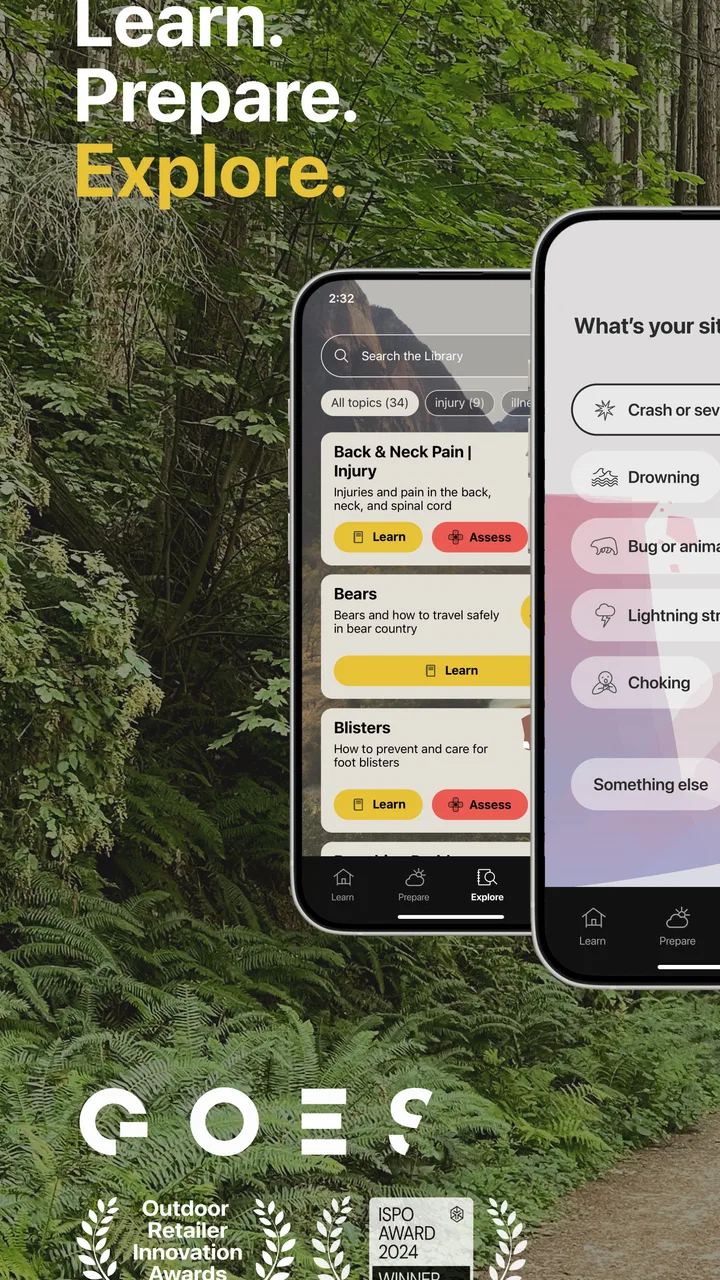
GOES: Outdoor Health & Safety
- 3.2
- Rating
- 10.00K
- Installs
- Free
- Price

 Analysis by App-foxy
Outdoor plans often fail for very ordinary reasons: a route takes longer than expected, weather changes, someone feels unwell, or a small injury becomes difficult to manage away from home. GOES: Outdoor Health & Safety is aimed at that gap between casual preparation and a full specialist setup. I approached it as a practical medical app for people who spend time outside, rather than as a replacement for professional care. That distinction matters, because its value depends less on entertainment or constant daily use and more on whether it helps you think clearly before and during an outing.
The app is developed by GOES Developer and is free to install, with optional in-app purchases ranging from $1.99 to $99.99 per item. It sits in the medical category, carries an Everyone age rating, and has reached over ten thousand installs. Its average rating is 3.2 from around forty-six ratings, so I would not treat its public reception as a reason to install blindly. Instead, I would judge it by the kind of outdoor planning I actually need. For a short walk near familiar roads, a normal weather app and a phone contact list may be enough. For remote recreation, a dedicated outdoor health and safety guide can be more useful.
How I would decide whether GOES belongs on my phone
The first question is not whether the app sounds useful, but what kind of uncertainty I want it to reduce. A good outdoor safety tool should help me prepare before leaving, find relevant guidance without wasting time, and support sensible decisions when conditions are less comfortable than expected. It should also be easy enough to use when I am tired, cold, stressed, or dealing with another person’s problem. Those are more useful tests than simply counting screens or judging the app by its short store description.
You May Also Like

 AccuWeather: Weather Radar
AccuWeather Review: A Quick, Clear Forecast for Everyday Decisions
For everyday plans, the best forecast is the one you can understand quickly. AccuWeather makes rain timing, radar, and local conditions easy to act on, with a few trade-offs.

 Hill Climb Racing
Why Hill Climb Racing Still Turns Crashes Into One More Run
A tiny car, a bumpy hill and one more upgrade: Hill Climb Racing keeps resurfacing because its simple chaos makes every near-miss feel personal.

 AliExpress - Shopping App
AliExpress Makes Global Shopping Feel Personal, but Shoppers Bear the Risk
AliExpress turns a global marketplace into a pocket-sized discovery engine. Its reach is useful, its shopping loop compelling, and its trade-offs easy to miss.

 Lords Mobile: Kingdom Wars
Lords Mobile Is a Kingdom-Building Routine, Not a Quick Match
A case-by-case verdict on the building, battles, device demands, and social commitments that make Lords Mobile rewarding for some players and exhausting for others.

 PDF Scanner app - TapScanner
TapScanner Makes Paperwork Easier to Capture, Check, and Share
TapScanner makes scanning with a phone feel less like a rescue operation and more like a dependable step in getting work done. Its capture tools are useful, though not flawless.

 Block Blast!
 Shows How Much a Puzzle Game Can Leave Out
A quiet grid game shows why puzzle players increasingly value instant clarity, repeatable skill and low-pressure play—and where the genre still needs to catch up.
More From Our News Desk
View All News


I also look at the difference between prevention and response. Prevention means thinking about clothing, water, route difficulty, communication, and likely health concerns before setting out. Response means knowing what to do when something has already happened. GOES is most interesting when it connects those two moments. A guide that only offers general educational material may be fine at home but less helpful beside a trail. On the other hand, an app that encourages people to diagnose serious symptoms through a phone should be treated cautiously. I prefer a tool that supports calm first steps and sensible escalation.
My practical test would be simple: install it while connected to a reliable network, open the main areas, and learn where the information I might need is located. I would not wait until an accident to explore it. I would also check how comfortably the text can be read outdoors, whether the navigation feels obvious, and whether important material remains usable when reception is poor. These habits are especially important for a medical guide, because searching under pressure is itself a safety risk.
GOES is running as version 5.5.2 and supports Android 7.0 or later. That gives it a broad compatibility range for many older phones, although compatibility alone does not guarantee a smooth experience on every device. I would update it before a significant trip, then open it once afterward to make sure the version behaves as expected. If the app depends on content that must be loaded from the internet, I would prepare a backup plan rather than assume a distant trail will provide a signal.
What I found useful in an everyday outdoor scenario
Imagine I am taking a day hike with a friend who is not used to uneven terrain. Before leaving, I can use an app like this as a prompt to discuss the route, likely exposure, personal health concerns, and what we would do if one of us had to stop. That conversation is an underrated benefit. It turns “we will be fine” into a more concrete plan without requiring either person to be an expert.
During the outing, the best use is not frantic browsing. If my friend develops a minor problem, I would first move us to a safer position, assess the situation, and use the relevant guidance as a reminder of sensible next steps. I would keep emergency services, local instructions, and direct human help ahead of any app. The app can support judgment, but it cannot see the person, examine an injury, or understand the entire environment.
Afterward, I would use the experience to improve the next trip. If we underestimated water, packed poorly, or chose a route beyond our ability, the app becomes part of a preparation routine rather than a one-time emergency download. That is one of the less obvious ways a safety guide can earn its place: not by being opened constantly, but by helping users notice patterns in their planning.
Where this app has a practical advantage
The clearest strength is focus. A general search engine can find almost anything, but it also produces distractions, conflicting explanations, and pages designed for reading rather than quick decisions. A medical app built around outdoor concerns has a better chance of keeping the subject connected to the setting. When I am preparing for a walk, camping trip, or other open-air activity, I do not want to assemble advice from unrelated searches every time.
It also offers a middle ground between doing nothing and carrying a large collection of specialist resources. Many casual outdoor users do not need an advanced navigation platform, a training system, and a separate medical reference. GOES may appeal to someone who wants one dedicated place to support basic preparation and health awareness. That makes it particularly suitable for occasional hikers, families, volunteers, and people who are beginning to spend more time outdoors.
Another advantage is accessibility. The Everyone rating makes it appropriate for a broad household audience, although adults should still guide children through serious medical information. The app is free to start using, which lowers the barrier for someone who wants to evaluate its approach before committing to a paid specialist product. The optional purchases are worth examining carefully inside the app, especially because the upper end of the listed range is substantial. Free entry is helpful, but it does not automatically mean every useful part is free.
I would also give it credit for encouraging preparation rather than relying only on rescue. Outdoor safety is often decided before the first step: choosing a realistic activity, recognizing personal limits, and carrying what is appropriate. A guide that prompts those decisions can be more valuable than one that is impressive only after something goes wrong. That is the sort of quiet usefulness I would look for here.
Important limits before relying on it
The public rating of 3.2 from around forty-six ratings suggests a mixed experience among the people who chose to rate it. That is not enough to explain every complaint, but it is enough for me to recommend testing the app personally before a demanding trip. I would pay attention to loading, readability, organization, and whether the information feels usable rather than merely present.
I would not use GOES as my only emergency resource. A phone battery can run down, reception can disappear, and an app cannot replace local emergency numbers, a first-aid course, suitable equipment, or an informed companion. For serious symptoms, breathing trouble, major bleeding, suspected spinal injury, severe allergic reaction, or rapidly worsening illness, contacting emergency services and following local professional guidance comes first.
There is also a human-factor limitation. When people are frightened, they often skim. Long explanations, unfamiliar terminology, or unclear categories can make a good reference less useful. My advice is to explore the app at home, identify the sections most relevant to your activities, and avoid assuming that an emergency is the right time to learn the interface. If you are responsible for a group, explain your plan to them before leaving.
The purchase structure deserves a deliberate look as well. Because the app is free but includes optional items priced from $1.99 to $99.99, I would not approve purchases automatically. I would first establish what the free version covers, what an optional item adds, and whether that addition solves a genuine problem for my trips. Someone who only takes short walks may gain little from spending heavily, while a frequent outdoor user may consider a useful expansion worthwhile if it clearly improves preparation.
How GOES compares with the usual alternatives
Compared with a general web search, GOES should be more convenient when I already know that my question concerns outdoor health and safety. Search engines are broader and often better for official local information, current alerts, or finding a nearby service. Their weakness is that I must judge the quality and relevance of every result. I would use search for location-specific details and GOES for a more focused reference workflow.
Compared with a first-aid manual, the app is easier to carry and potentially faster to consult, while a printed manual does not depend on battery life or a working screen. A book can also be easier to annotate and study in advance. I would not choose one exclusively. For a serious trip, a compact printed reference and basic first-aid knowledge provide resilience; the phone app adds convenience and portability.
Compared with navigation apps, GOES serves a different purpose. Mapping tools are usually the better choice for route planning, position awareness, and finding roads or trails. They may show terrain or travel information that a medical guide is not designed to provide. I would pair the categories rather than expect one to replace the other: navigation helps me understand where I am, while a health and safety guide can help me think about what to do when the outing becomes physically difficult.
Compared with weather services, the difference is equally important. A weather app is stronger for changing forecasts and alerts, while GOES is more relevant to the human consequences of being outdoors. Before leaving, I would check both kinds of information. Weather determines whether the plan is sensible; health and safety guidance helps me prepare for the strain, exposure, or minor problems that can follow from that plan.
Frequent climbers, backcountry travelers, or users with specific medical conditions may prefer highly specialized resources, formal training, or advice from a qualified professional. GOES is not the right substitute for those needs. Its likely audience is broader: people who want a dedicated outdoor safety companion without building an elaborate technical setup.
The real cost of switching to it
Because the app is free to install, the initial financial risk is low, but the time cost is easy to overlook. I would spend a quiet few minutes learning its structure, checking the material relevant to my activities, and deciding whether optional purchases are justified. That preparation is not wasted even if I eventually choose another tool, because it clarifies what I actually need from an outdoor guide.
There is also a switching cost if I already rely on a familiar system. Moving from a printed guide or a trusted first-aid resource means changing habits, and habits matter during stressful moments. I would not replace a resource that I already understand just because a new app looks convenient. Instead, I would use GOES alongside it for several ordinary outings and see whether it genuinely makes preparation or reference easier.
For families and groups, the cost includes coordination. If only one person knows where the information is, the benefit is limited when that person is injured or separated. I would show companions the basic layout and agree on who carries the phone, who carries physical supplies, and how we will call for help. This is a concrete advantage of testing the app early: it reveals whether the tool supports a shared plan or merely sits unused on one device.
I would also protect the phone itself. A waterproof pouch, spare battery, and offline backup matter more than a polished interface when conditions turn bad. The app should be one layer in a safety system, not the system itself. That trade-off is easy to miss when evaluating any health tool from a comfortable room.
Who should install it, and who should skip it
I can recommend trying GOES to occasional hikers, outdoor beginners, parents planning simple trips, and anyone who wants a focused health-and-safety reference on an Android phone. It is especially reasonable for people who tend to prepare casually and would benefit from a repeatable checklist mindset. The free entry point makes experimentation straightforward, provided purchases are reviewed rather than accepted automatically.
I would be more cautious if I were planning remote or technically demanding adventures. In that situation, I would want formal training, dependable navigation, local conditions, appropriate equipment, and a communication plan before treating any app as useful. I would also look elsewhere if my main need were route tracking, live weather, medical record management, or condition-specific clinical advice. Those are different jobs, and a focused outdoor guide should not be judged as though it were designed to perform all of them.
Users who dislike reading on a phone, regularly travel without reliable power, or already carry a trusted printed reference may find little reason to change. Likewise, anyone expecting the app to make emergency decisions for them will probably be disappointed. The strongest case for GOES is not automation; it is structured preparation and quick access to relevant guidance when the situation is still manageable.
My recommendation after weighing the trade-offs
GOES: Outdoor Health & Safety is best viewed as a preparation companion, not a digital substitute for training or emergency help. I like the idea of having an outdoor-focused medical reference available, and the free installation makes it easy to test against real routines. Its value will depend on how clearly the content is organized on your device and whether the available material matches the activities you actually do.
Before a trip, I would open it at home, review the relevant guidance, check any purchase prompts, and keep a second plan for poor reception or a dead battery. I would then use it on a low-risk outing before taking it somewhere remote. That approach gives me a fair assessment without placing too much trust in an unfamiliar tool.
My final view is cautiously positive for everyday outdoor users who want a dedicated health and safety guide and are willing to verify its usefulness personally. The mixed average rating means I would not recommend installing it sight unseen as the only resource in a serious adventure. For the right user, however, it can add structure to preparation and make a phone more helpful when a normal outing becomes unexpectedly uncomfortable.
GOES: Outdoor Health & Safety was released on July 8, 2021, and its current version is 5.5.2. Those details make it easy to identify in the app catalog, but the more important decision is practical: install it, learn it before you need it, and keep professional help, local guidance, equipment, and common sense in charge of serious situations.
FAQs for GOES: Outdoor Health & Safety
01What is GOES: Outdoor Health & Safety used for?
GOES is an outdoor safety and health app designed to help people prepare for and manage adventures such as hiking, camping, climbing, skiing, and other remote activities. It can provide access to safety information, trip-related tools, emergency resources, and health guidance. It is best viewed as a support tool for outdoor planning, not as a replacement for professional medical care, local rescue services, or responsible preparation.
02Does GOES work without an internet connection?
Some GOES features may require an internet connection, particularly account functions, content updates, location-based services, communication tools, or access to online resources. Before heading into an area with weak coverage, users should open the app, review the information they need, and check whether relevant content is available offline. You should also carry a physical map, backup power, and another reliable way to contact emergency services.
03Can GOES automatically contact emergency services?
Users should not assume that GOES automatically contacts emergency responders in every situation. Emergency features can depend on the phone model, operating system permissions, GPS availability, mobile coverage, internet access, and the specific function being used. Always read the app’s instructions carefully and learn the emergency number for your location. In a serious situation, contact local emergency services directly whenever possible.
04What permissions and personal information does GOES require?
Depending on the features you use, GOES may request permissions such as location access, notifications, camera or microphone access, and account-related information. Location permissions can support navigation, trip monitoring, or safety functions, while notifications may be needed for alerts. Review the app’s privacy policy and your device settings before granting access, and disable permissions that are not necessary for the features you intend to use.
05Is GOES suitable for medical emergencies and outdoor risk management?
GOES can be useful for preparation, awareness, and general outdoor safety, but it should not be treated as a medical diagnostic tool or a substitute for trained professionals. App information may not account for your complete health history, environmental conditions, or rapidly changing risks. Carry appropriate first-aid supplies, tell someone about your itinerary, check weather and route conditions, and seek professional help for injuries or urgent symptoms.
Pros
- Provides official weather and hazard alerts for outdoor activities.
- Useful location-based information for hiking
- camping
- and travel planning.
- Can help users prepare for severe weather and environmental risks.
- Simple safety-focused design makes key alerts easy to find.
- Supports more informed decisions before heading outdoors.
Cons
- Coverage and alert quality may vary by region and local data sources.
- Requires location access for the most relevant safety notifications.
- Frequent alerts can become distracting during changing weather conditions.
- Some features may depend on an internet connection or mobile signal.
- Battery use may increase when location services run continuously.

GOES: Outdoor Health & Safety
Gallery